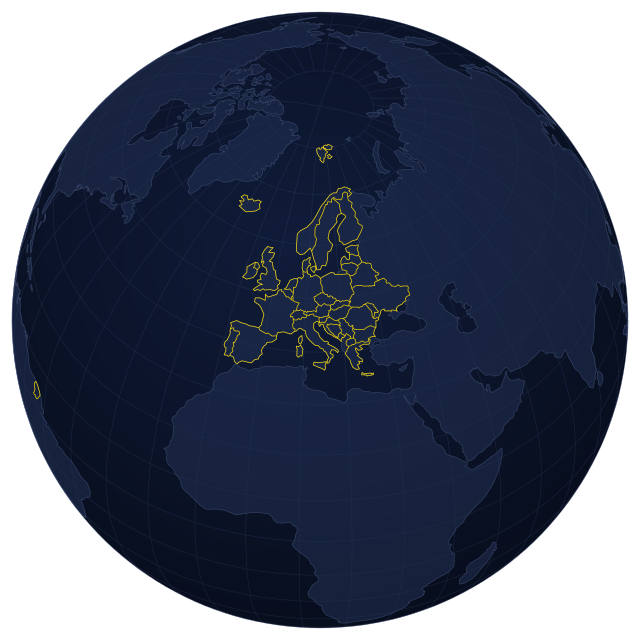

Short answer: because it’s a quality play, not a cost play. A Polish senior works in the same time zone as your Dutch team, under the same EU rules, and speaks English well enough to keep a stand-up moving without friction. The price is a pleasant side effect, not the reason. It’s no accident that Renforza calls both Amsterdam and Krakow home.
How big is the Polish talent pool, really?
Big enough to build a real hiring strategy on. Poland has more than 600,000 IT professionals, the largest and most mature pool in Central Europe. That’s not a niche you exhaust after three hires. It’s a deep market with seniors in nearly every stack a scale-up needs. Mature matters here too. This isn’t a country that just started shipping software. It’s an ecosystem with years of experience building for international clients. For a growing company, that depth counts for more than any hourly rate. You’re not hiring a spare pair of hands. You’re hiring someone who’s still contributing three years from now.
What about the engineering?
Poland has one of the strongest hard-science traditions in Europe. In the OECD’s PISA study, Polish students consistently score above the Western average in math and science, which happen to be exactly the two disciplines good engineers run on. The result is a generation of developers who are rigorously trained and used to working on international teams. The foundation gets laid in school, and that foundation is demonstrably solid.
And the language?
Language isn’t a barrier. In EF’s 2025 English Proficiency Index, Poland ranks fifteenth out of one hundred and twenty-three countries, in the same top band as the Netherlands, which has led the list for seven years. Poland’s tech hubs score even higher: Krakow, Poznan, and Gdansk all sit above the national average. A meeting in English runs smoothly on both ends of the call. That’s the difference between quick feedback loops and the slow, lossy back-and-forth you tend to get with farther-flung offshore locations. For a scale-up that wants to move fast, clear communication isn’t a nice-to-have. It decides how often you have to course-correct, and how much context gets lost between what you ask for and what actually gets built.
Does my IP and GDPR coverage still hold?
Yes, and that’s less obvious than it sounds. Poland is inside the EU, so you’re working under the same GDPR and the same legal system. Your intellectual property lives in an ordinary European contract, without the legal uncertainty of an agreement you’d have to enforce on another continent. No exotic export rules, no data questions that keep your legal team up at night. For a Dutch scale-up, that’s the difference between a vendor inside your own playing field and a risk you have to manage separately. Anyone who’s worked with an offshore party outside the EU knows the difference. Out there, every agreement starts with the question of which law even applies. Inside the EU, you don’t ask that question.
So what does it cost?
Here are the honest numbers, with a caveat. Vendors like Qubit Labs and Index.dev put a senior in nearshore Eastern Europe at roughly 40 to 70 euros an hour, against 100 to 175 euros for comparable talent in the Netherlands. Treat that as vendor claims, not a guarantee. These are ballpark figures from parties with an interest, and the real rate depends on stack, seniority, and contract structure. More to the point: price isn’t the argument. If cheap is your only criterion, you’re choosing wrong. The argument is the talent pool, the quality, and the proximity. The cost is a consequence, not a goal.
Why Poland and not Romania?
Let’s be straight: Poland isn’t the cheapest country in the region. Romania comes in lower on rate, and there are other places where you’d save on paper. Poland doesn’t win on price. It wins on depth and maturity of the market. And there’s a reason that’s specific to us. Thomas literally speaks Dutch and Polish, and that’s the bridge. No middleman, no translation layer, just someone who understands both sides of the table in their own language. That makes Poland our natural home base. When a search works better with talent from Romania, Portugal, or Ukraine, we handle it through partners. Language is our reason, not a dogma.
What it’s not
Nearshoring is not a euphemism for cheap labor at a distance. It only works when the quality holds up and the collaboration actually runs. That’s why we qualify every search and every candidate with our MATCHED framework, on both sides of the table. A placement that starts grinding after ninety days helps no one, in Poland no more than in the Netherlands. If you want to see what that looks like for your team, read on at the page for employers. The full story is there, from intake to placement.
More from this cluster: the country comparison, and building a nearshore team in ninety days.